Six Button Control Pad (Mega Drive)
From Sega Retro

| ||||||||||||||||||||||||||||||||||||||||
| Six Button Control Pad | ||||||||||||||||||||||||||||||||||||||||
|---|---|---|---|---|---|---|---|---|---|---|---|---|---|---|---|---|---|---|---|---|---|---|---|---|---|---|---|---|---|---|---|---|---|---|---|---|---|---|---|---|
| Made for: Sega Mega Drive | ||||||||||||||||||||||||||||||||||||||||
| Manufacturer: Sega | ||||||||||||||||||||||||||||||||||||||||
|
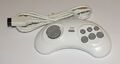
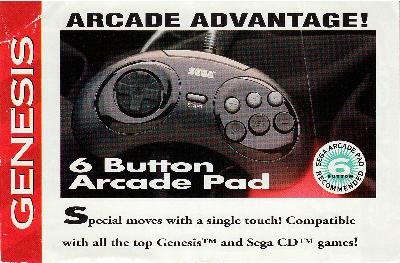
The Six Button Control Pad became the de facto controller for the Sega Mega Drive, replacing the standard Control Pad internationally around 1993/1994. It is officially known as the 6 Button Arcade Pad in North America and the Fighting Pad 6B (ファイティングパッド6B) in Japan.
Contents
Hardware
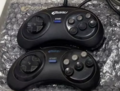
There are two main types of Six Button Control Pad, a smaller model originally intended for Japan, and a larger one intended for the west. The differences in size are due to a perception that the Japanese and people living in similar Asian countries have genetically smaller hands - it is an idea that passed through to the Sega Saturn and even to the Xbox before the realisation it might have been easier to produce one single pad for all regions. Indeed the larger variant was phased out by the end of the decade to cut costs and the Japanese variant would replace it worldwide.
The Six Button Control Pad is functionally identical to the previous pad but features three extra face buttons (or "triggers");  ,
,  and
and  , placed above
  ,
,  and
and  . The START button was moved to the centre of the pad, similar to Nintendo's set of controllers.
In most regions the Six Button Control Pad was released with Street Fighter II': Special Champion Edition, which made use of the six-button layout. Though the game had been released on the Super NES, it had to assign moves to the  and
and  buttons - the Mega Drive version is therefore more analogous to the original arcade version (and also means a separate arcade stick does not necessarily need to be purchased).
Some games do not function with the Six Button Control Pad. To fix this situation, Sega added a MODE button on the top right of the controller. If held while the system is booting, the controller will revert back to a three button pad. Many six button games make use of the MODE button within play, bringing the total number of buttons to eight (plus the D-Pad). Since the Super NES controller also has eight buttons, this made developing multiplatform games for both consoles easier.
There are some minor aesthetic differences between models. Japanese control pads have blue START buttons, PAL models have red ones, and North America has grey ones.
The Six Button Control Pad would be used as a basis for the Sega Saturn Control Pad, though the MODE button would be scrapped in favour of an extra two shoulder buttons, and .
Compatible games
Mega Drive
- Art of Fighting (1994)
- AWS Pro Moves Soccer (1993)
- Batman Forever (1995)
- Boogerman: A Pick and Flick Adventure (1994)
- Brutal: Paws of Fury (1994)
- Bubba 'N' Stix (1994)
- Chou Kyuukai Miracle Nine (1995)
- ClayFighter (1994)
- College Football's National Championship (1994)
- College Football's National Championship II (1995)
- Comix Zone (1995)
- Commandos (2002)
- Contra: Hard Corps (1994)
- Darius Extra Version (2021)
- Davis Cup Tennis (1993)
- Desert Demolition Starring Road Runner and Wile E. Coyote (1995)
- Double Dragon V: The Shadow Falls (1994)
- Dragon Ball Z: Buyuu Retsuden (1994)
- Dragon: The Bruce Lee Story (1994)
- Duke Nukem 3D (1998)
- Duke Nukem 3D (2015)
- Dyna Brothers 2 (1993)
- Eternal Champions (1993)
- Fatal Fury 2 (1994)
- Fever Pitch Soccer (1995)
- Garfield: Caught in the Act (1995)
- Gouketsuji Ichizoku (1994)
- The Great Circus Mystery Starring Mickey & Minnie (1994)
- Greatest Heavyweights (1993)
- Instruments of Chaos Starring Young Indiana Jones (1994)
- International Superstar Soccer Deluxe (1996)
- Judge Dredd (1995)
- Justice League Task Force (1995)
- Lemmings 2: The Tribes (1994)
- The Lion King (1994)
- Lord Monarch: Tokoton Sentou Densetsu (1994)
- The Lost Vikings (1993)
- Marsupilami (1995)
- Mega Turrican (1994)
- MiG-29 Fighter Pilot (1993)
- Mortal Kombat (1993)
- Mortal Kombat 3 (1995)
- Mortal Kombat II (1994)
- NBA Action '94 (1994)
- NBA Action '95 Starring David Robinson (1995)
- NFL '95 (1994)
- Nightmare Circus (1996)
- Phantom 2040 (1995)
- Pinocchio (1996)
- Pitfall: The Mayan Adventure (1994)
- Primal Rage (1995)
- Ranger-X (1993)
- Rise of the Robots (1994)
- Samurai Shodown (1994)
- Shaq Fu (1994)
- Shinobi III: Return of the Ninja Master (1993)
- The Story of Thor: A Successor of the Light (1994)
- Street Fighter II': Special Champion Edition (1993)
- Streets of Rage 3 (1994)
- Striker (1995)
- Super Street Fighter II: The New Challengers (1994)
- Time Killers (1996)
- ToeJam & Earl in Panic on Funkotron (1993)
- True Lies (1995)
- Ultimate Mortal Kombat 3 (1996)
- Urban Strike (1994)
- Virtua Fighter 2 (1996)
- Virtua Racing (1992)
- VR Troopers (1995)
- Weaponlord (1995)
- Williams Arcade's Greatest Hits (1996)
- World Heroes (1994)
- World Series Baseball '95 (1995)
- World Series Baseball '96 (1996)
- WWF WrestleMania: The Arcade Game (1995)
- Yuu Yuu Hakusho: Makyou Toitsusen (1994)
Mega-CD
- After Burner III (1992)
- Battlecorps (1994)
- BC Racers (1994)
- Brutal: Paws of Fury (1994)
- Eternal Champions: Challenge From the Dark Side (1995)
- Fatal Fury Special (1994)
- Loadstar: The Legend of Tully Bodine (1994)
- Mortal Kombat (1993)
- Pitfall: The Mayan Adventure (1994)
- Prize Fighter (1993)
- Samurai Shodown (1994)
- Shin Megami Tensei (1994)
- Supreme Warrior (1994)
- Urusei Yatsura: Dear My Friends (1994)
- Wing Commander (1994)
- WWF Rage in the Cage (1993)
32X
- After Burner Complete (1995)
- BC Racers (1994)
- Blackthorne (1995)
- Cosmic Carnage (1994)
- Darxide (1996)
- Doom (1994)
- Golf Magazine: 36 Great Holes Starring Fred Couples (1995)
- Metal Head (1995)
- Mortal Kombat II (1994)
- Pitfall: The Mayan Adventure (1994)
- Primal Rage (1995)
- Sangokushi IV (1995)
- Spider-Man: Web of Fire (1996)
- Star Trek: Starfleet Academy Starship Bridge Simulator (1995)
- Star Wars Arcade (1993)
- Stellar Assault (1995)
- Virtua Fighter (1993)
- Virtua Racing Deluxe (1994)
- WWF WrestleMania: The Arcade Game (1995)
Incompatible games
- note: this list is incomplete
- Forgotten Worlds (reads controllers too quickly for the pad to keep up — there is no delay between setting TH and reading the new values, and apparently regular controllers are fast enough to handle this, but not the 6-button)
Games requiring 3-button mode
- Arch Rivals
- Beast Wrestler (cursor moves too fast)
- Double Dragon II: The Revenge (there's a bit of input lag in 6-button mode)
- The Faery Tale Adventure (cursor for item selection at shop menu goes wild in 6-button mode)
- Golden Axe II
- John Madden Football (cursor moves too fast on some menus)
- Mario Lemieux Hockey (cursor moves too fast on some menus)
- Ms. Pac-Man (Ms. Pac-man controls badly in 6-button mode)
- Starflight (cursor moves too fast on some menus, like save slot selection)
- Sunset Riders (can't access "2 Players" and "Versus" modes if both players are in 6-button mode)
- The Terminator (Mega-CD) (some menus move too fast (and cheat codes are hard to input) but is fine in-game)
King of the Monsters requires an abnormally long press of the mode button in order to work.
Mode Button
Though the MODE button is officially used on a Six Button Control Pad to switch between six button and three button modes, many developers utilised it in-game as an extra button for gameplay. In many situations the MODE button's usage is kept hidden from the player by not being listed in manuals, thus its use is not widely documented.
List of Games which use the Mode Button
- Aerobiz Supersonic
- After Burner Complete
- After Burner III
- Batman Forever
- Battlecorps
- Doom
- Dragon: The Bruce Lee Story
- Dragon Ball Z: Buyuu Retsuden
- Fatal Fury 2
- The Lost Vikings
- Metal Head
- Nightmare Circus
- Phantom 2040
- Star Wars Arcade
- The Story of Thor
- TechnoClash
- Williams Arcade's Greatest Hits
- WWF Royal Rumble
Hidden compatibility
Though these games are generally designed only with 3-button control pads in mind, support for the Six Button Control Pad is added to these games anyway, usually as a means of accessing hidden features such as cheats, Easter eggs or debugging features.
- Astérix and the Power of the Gods - Used for accessing a level select.
- Chaotix - Extra sound test controls.
- Combat Cars - Used for a level select.
- Sonic Crackers -
 ,
,  and
and  have the same function as
  ,
,  and
and  .
. - Vectorman - Used for entering cheat codes.
- Vectorman 2 - Used for entering cheat codes.
Technical information
In order to maintain backwards-compatibility with existing games, the 6-button gamepad acts the same as the 3-button if the controller inputs are read by the program a maximum of four times per frame. Reading the 3-button gamepad takes two cycles (once with TH=1 to read  ,
,  ,
,  ,
,  , , and ; and once with TH=0 to read and START ), and the 6-button gamepad allows this to occur twice. It then reports the state of the extra buttons when the TH line is changed after the fourth cycle.
The full controller state is read in 8 cycles:
| Cycle | TH out | TR in | TL in | D3 in | D2 in | D1 in | D0 in |
|---|---|---|---|---|---|---|---|
| 1 | HI | C | B | Right | Left | Down | Up |
| 2 | LO | Start | A | 0 | 0 | Down | Up |
| 3 | HI | C | B | Right | Left | Down | Up |
| 4 | LO | Start | A | 0 | 0 | Down | Up |
| 5 | HI | C | B | Right | Left | Down | Up |
| 6 | LO | Start | A | 0 | 0 | 0 | 0 |
| 7 | HI | C | B | Mode | X | Y | Z |
| 8 | LO | Start | A | --- | --- | --- | --- |
Note: For the 8th cycle, '---' indicates "don't care". These values are all 1 on the 6-button controller, but may be mapped to other buttons on third-party controllers. Software expecting 6-button controllers should simply ignore these values. (6-button detection should be done on the 6th cycle, which presents four 0's on the D lines.)
The controller's internal counter automatically resets after the eighth cycle. It also resets if it doesn't detect a rising-edge (0 to 1) transition on the TH line within 1.5 ms, which ensures that most games that don't support the extra buttons won't read them accidentally.
Some games incorrectly read the controller more than twice per frame, which may cause them to read the wrong set of buttons. If the MODE button is held in while starting the Mega Drive console, the 6-button gamepad will disable the extra buttons and act identically to a 3-button gamepad. (That is, the controller's internal counter will reset after the first two cycles instead of after eight cycles.)
Gallery
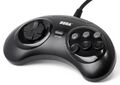
US model
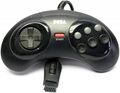
EU model
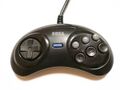
JP model
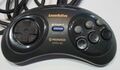
LaserActive model
BR model (grey)

JP model PCB
March 1993 prototype.

PT "Mega II" model
CN "Tianli" model


Patents
USD349527
Magazine articles
- Main article: Six Button Control Pad (Mega Drive)/Magazine articles.
Promotional material


also published in:
- Sega Visions (US) #17: "February/March 1994" (199x-xx-xx)[4]

also published in:
- GamePro (US) #64: "November 1994" (1994-xx-xx)[5]
- Sega Visions (US) #22: "December/January 1994/1995" (1994-xx-xx)[6]
- Sega Visions (US) #23: "February/March 1995" (199x-xx-xx)[7]
- Sega Visions (US) #24: "May 1995" (1995-xx-xx)[8]
Physical scans
| Sega Retro Average | ||||||||||||||
|---|---|---|---|---|---|---|---|---|---|---|---|---|---|---|
|
 |
62 |
|---|---|
| Based on 2 reviews | |
| Mega Drive, JP |
|---|
   Cover
|
| Mega Drive, US |
|---|
  Cover
|
| Mega Drive, US (newer) |
|---|
  Cover
|
| Mega Drive, US (Sega Club) |
|---|
    Cover
|
| Mega Drive, EU (-50) |
|---|
|

| Mega Drive, EU (-50 B) |
|---|
|

| Mega Drive, EU (-44) |
|---|
  Cover
|
| Mega Drive, PT (Mega Game II) |
|---|
  Cover
|
| Mega Drive, BR |
|---|
 Cover
|
| Mega Drive, BR (Master System branding) |
|---|
 Cover
|
| Mega Drive, BR (grey) |
|---|
 Cover
|
| Mega Drive, CA |
|---|
  Cover
|
| Mega Drive, TR |
|---|
 Cover
|
| Mega Drive, AS† |
|---|
|
| Mega Drive, CN (Tianli) |
|---|
|
External links
References
- ↑ http://sega.jp/fb/segahard/md/fighting6b.html (Wayback Machine: 2012-11-14 01:16)
- ↑ VideoGames & Computer Entertainment, "June 1993" (US; 1993-0x-xx), page 21
- ↑ Sega FY 1997 Brand Review, page 3
- ↑ Sega Visions, "February/March 1994" (US; 199x-xx-xx), page 131
- ↑ GamePro, "November 1994" (US; 1994-xx-xx), page 167
- ↑ Sega Visions, "December/January 1994/1995" (US; 1994-xx-xx), page 57
- ↑ Sega Visions, "February/March 1995" (US; 199x-xx-xx), page 89
- ↑ Sega Visions, "May 1995" (US; 1995-xx-xx), page 101
- ↑ Gamers, "März/April 1994" (DE; 1994-03-04), page 40
- ↑ Mega, "February 1994" (UK; 1994-01-20), page 48